Is It Possible to Remove Tartar At Home?

Updated: May 14
Tartar is the progression of dental plaque, which can make your teeth more vulnerable to cavities, gum disease, and gum recession leading to sensitive teeth.
Removing tartar from your teeth is not as simple as brushing more vigorously or flossing more often. It is not possible to remove tartar at home, or by yourself. The only way to successfully remove tartar is a professional dental cleaning (scaling) with your dentist.
What Is Tartar and How Does It Form?
Tartar is dental calculus; a hard mineral-like substance that forms on the surface of teeth as a result of built up of bacteria. Tartar is the combination of dead bacteria from poor oral health and proteins in saliva.
As we eat and drink, bacteria naturally collect on our teeth, resulting in a sticky film (plaque). Without good oral care, plaque remains on the surface of teeth and gradually hardens into tartar. The calcified substance can form in as little as 24-72 hours.
Poor oral hygiene is the primary cause of tartar. A high sugar intake or a smoking can also contribute to the development of tartar.
Can Tartar Be Removed at Home?
No - tartar has developed beyond the point of being able to reasonably remove with good oral health. Tartar cannot be removed by yourself, for two main reasons:
It is too hard to be broken down by tooth brushing or flossing
It can form under the gum line
The hardened surface of tartar can only be broken down by specialised dental tools that break apart or scrap tartar off the surface of the tooth.
Do not attempt to remove tartar using household tools - doing so is ineffective, and more importantly, may cause irreparable damage to your teeth, enamel, and gums.
Tartar that forms under the gum line is not visible - only a dentist can assess where tartar has formed on your teeth or underneath your gums. This is crucial to ensuring that all traces of tartar are removed.

How Does Dental Cleaning Remove Tartar?
During the appointment, your dentist will assess where the tartar has calcified. Once identified, we can use both ultrasonic and manual scaling tools to safely remove tartar.
Ultrasonic scaling tools have high frequency vibrations that break apart tartar. Fine-tipped manual scaling tools are used to scrape away tartar in narrow spots. Removed tartar is flushed out of the mouth with water.
Professional scaling and cleaning can take anywhere between 30 minutes and 2 hours, depending on the amount of tartar and the difficulty of removal. Most standard scaling appointments are half an hour.
How to Determine Whether You Have Tartar
Tartar | Plaque | |
Appearance | Hard, calcified, and bumpy texture on the surface of teeth | Slimy or sticky film on the surface of teeth |
Stain colour | Darker yellow, brown, or black | Colourless or pale yellow |
Time for formation | Within a few days or weeks of poor oral hygiene | Within a few hours |
Removal/treatment | Professional dental cleaning | Regular brushing and flossing |
Dental risks if left | Periodontitis (severe gum infection), bone loss, tooth loss | Gingivitis (gum disease), cavities |
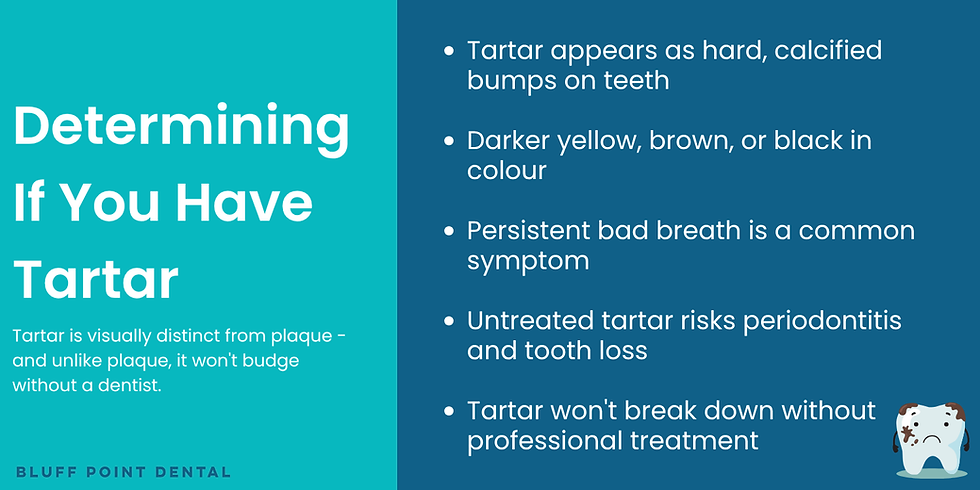
Tartar is visually distinct from plaque and the natural look of teeth - teeth with tartar have hard or calcified bumps on the surface. Tartar also tends to have a deeper yellow colour than plaque - it can also appear brown or black as it becomes discoloured from the food you eat or from the use of tobacco products.
Consistent bad breath (halitosis) is also another common symptom of tartar formation. The odour is caused by the presence of built up bacteria in the mouth.
If you notice any signs of tartar formation, book a dental cleaning appointment as soon as possible. Tartar will not break down or go away on its own. Letting tartar continue to settle will increase the likelihood of more severe dental issues developing including periodontitis and tooth loss.
How to Prevent Tartar From Forming
Practice good oral hygiene. Don’t underestimate the effectiveness of regular brushing and flossing to prevent dental plaque from building up.
Avoid smoking. Research shows that using tobacco products leads to an increased risk of poor oral health and tartar formation and puts you at risk of oral cancer.
Seeing your dentist for regular checkups. A routine dental cleaning once every 6 months is generally sufficient to prevent tartar from getting out of control.


Comments